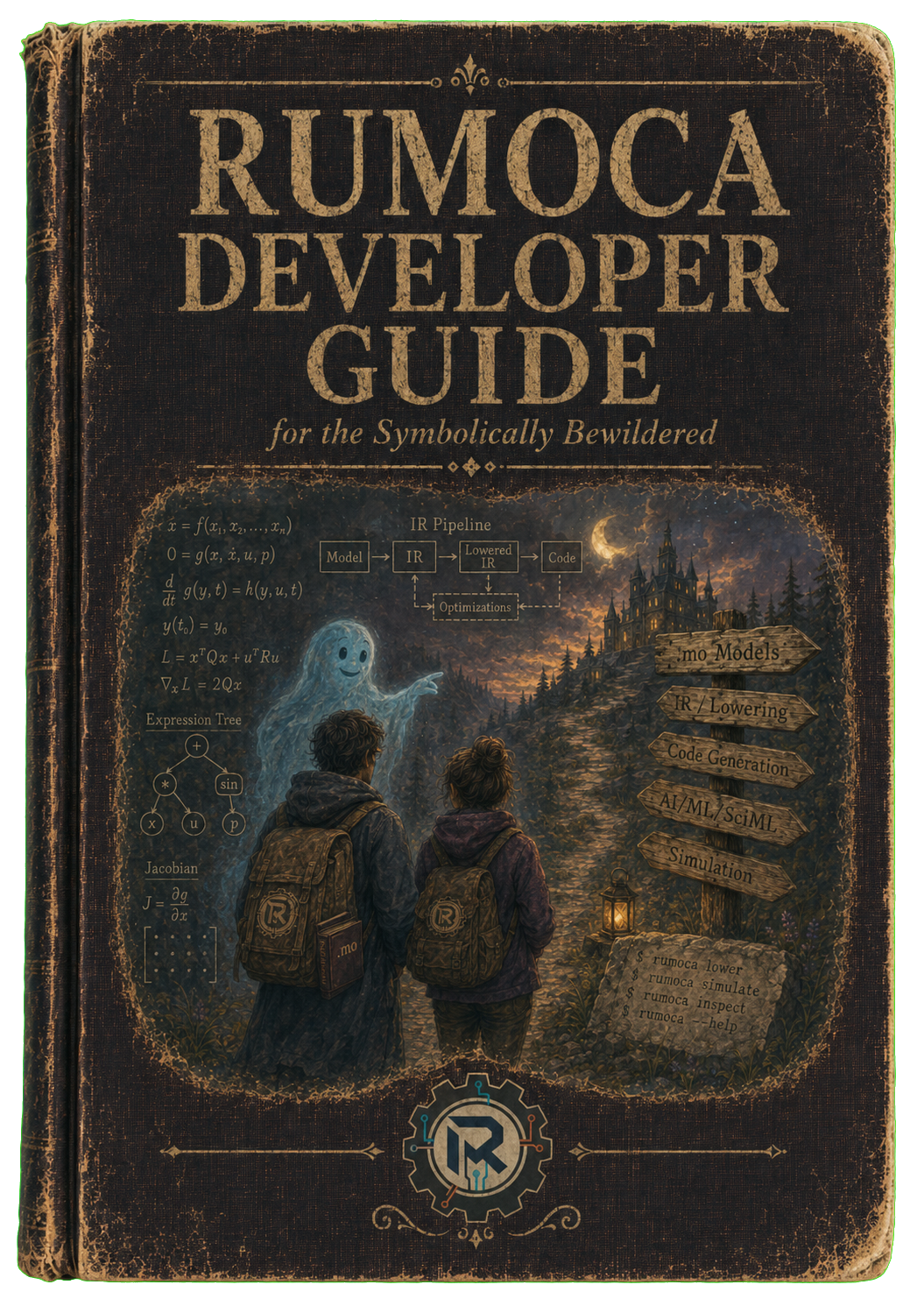
This book explains how the Rumoca compiler works and how to contribute to it. It is written for humans first: the chapters tell the story of a model moving through the pipeline, then point you at the code and the specs that own each piece.
Rumoca is a Modelica compiler written in Rust. It compiles Modelica models
to differential-algebraic equations (DAE), simulates them with pluggable
solver backends, and generates code for symbolic, compiled, and packaged
targets. The same compiler runs natively, in the rumoca-lsp language
server, and in WebAssembly in the browser.
How to Use This Book
- New to the codebase? Read the How the Compiler Works part in order — it follows a model from source text to simulation results.
- Fixing a bug or adding a feature? Start with Getting Started, then read the chapter for the pipeline stage you are touching, then read the spec that owns it.
- Looking up a rule? Skip this book and go straight to
spec/.
This Book Explains; the Specs Decide
Normative architecture and contribution rules live in
spec/, and
AGENTS.md is
the routing index from task to spec. This book deliberately does not
restate spec rules — it gives you the mental model that makes the specs easy
to read, and links to them. When this book and a spec disagree, the spec
wins (and a docs fix is welcome).
Philosophy in One Paragraph
Rumoca’s core scope ends at DAE generation (SPEC_0031): the compiler builds a stable, deterministic, solver-agnostic DAE, and everything downstream — solvers, runtimes, viewers, bindings, code generation targets — is a replaceable extension layered on that contract. Most architectural decisions in the codebase trace back to defending that boundary.
Prerequisites
You should be comfortable with Rust, basic compiler concepts (parsing, ASTs, type checking), and Git/GitHub workflows. Familiarity with Modelica helps but is not required — the user guide and the chapters here explain the concepts where they matter.